
When Science Surprises You: The Value of Following the Unexpected
Scientific Research · Phage Biology · Microbiology
Scientific discovery rarely follows a straight path.
While researchers begin with carefully designed questions and well-defined objectives, some of the most exciting breakthroughs emerge when the unexpected happens. Such serendipitous discoveries have shaped the history of science, opening entirely new directions of research that were never part of the original plan.
A recent observation at the Centre for Phage Biology and Therapeutics, Jos, Nigeria, led by Dr. Nnaemeka Emmanuel Nnadi, is a compelling example of how curiosity, careful observation, and scientific rigor can transform an unexpected finding into a promising new research opportunity.
An Unexpected Observation
The team was investigating phages targeting Xanthomonas, a bacterial pathogen responsible for serious diseases in several economically important crops.
As expected, phages were successfully recovered.
But during routine screening, something else caught the researchers’ attention.
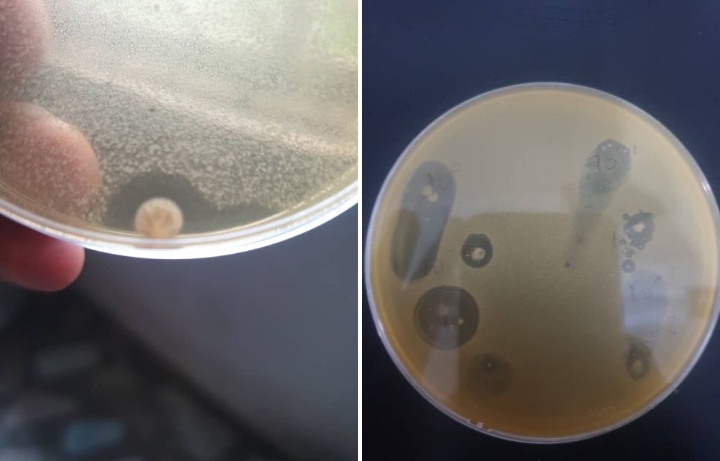
A yeast-like isolate appeared to inhibit the growth of Xanthomonas.
Rather than dismissing the observation as an anomaly, the team chose to investigate further. The isolate was cultured, the cells were removed by filtration, and the resulting cell-free filtrate was tested against the bacterium.
The filtrate produced clear zones of inhibition.
With no live cells present, the findings suggest that the organism secretes bioactive compounds capable of suppressing Xanthomonas. What began as a phage isolation study had unexpectedly revealed a promising new avenue of research.
When the Unexpected Becomes a Discovery
This is a powerful reminder that many of science’s greatest discoveries were never part of the original experimental design. They emerged because researchers paid attention to results that did not fit expectations instead of overlooking them.
A carefully planned protocol provides direction, but curiosity often determines where discovery leads.
At PhageAfrica, we celebrate not only successful outcomes but also the scientific mindset that embraces the unexpected.
Progress in research is rarely linear, and some of the most meaningful advances begin with a simple question:
“Why did that happen?”
Celebrating Scientific Inquiry
We commend Dr. Nnaemeka Emmanuel Nnadi and the team at the Centre for Phage Biology and Therapeutics, Jos, for exemplifying this spirit of scientific inquiry.
Through their continued contributions to phage and microbial research, they are helping to strengthen research capacity and innovation across Africa.
We look forward to seeing where this unexpected observation leads next.